

What is Hyundai’s Remote Smart Parking Assist?
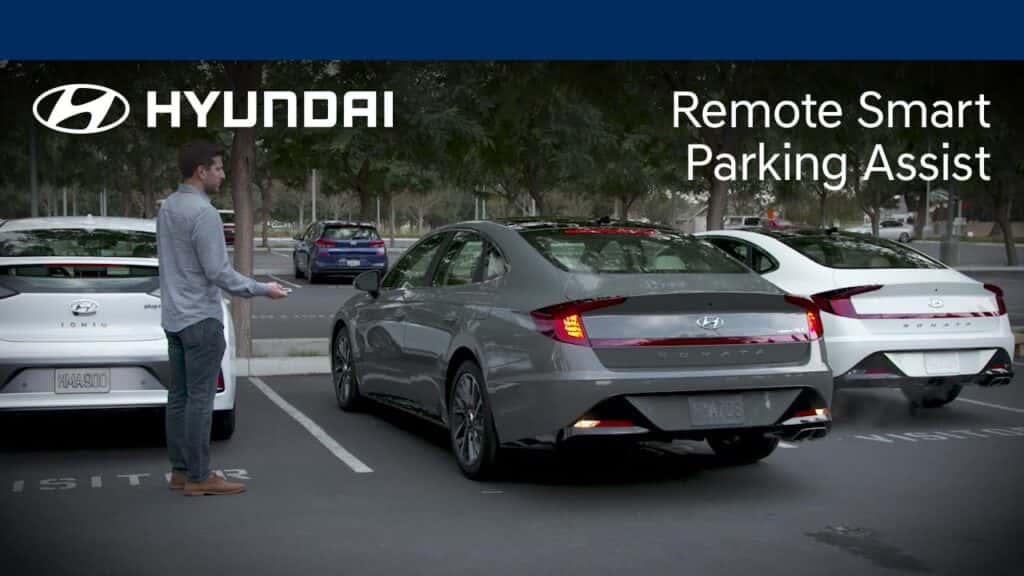
Parking in a tight spot is one of those small but genuinely stressful parts of driving. Whether you’re squeezing into a narrow city space or navigating a packed garage, the anxiety is real. Hyundai Remote Smart Parking Assist tackles that problem with a system that handles steering, acceleration, and braking so you don’t have to. If you’re curious whether RSPA belongs on your next vehicle, browse our new Hyundai inventory to see which models and trims have it available.
What Is Hyundai Remote Smart Parking Assist (RSPA)?
Hyundai Remote Smart Parking Assist, commonly called RSPA, is a self-parking technology that lets a Hyundai vehicle maneuver into or out of a parking space without the driver sitting behind the wheel. The system handles steering, acceleration, and braking, guiding the car into a space while you watch from outside. It’s Hyundai’s answer to one of the most common frustrations drivers face.
One key distinction worth knowing upfront: RSPA is not fully autonomous. You must hold the key fob button continuously throughout the maneuver. Release it and the car stops immediately. You also need to stay within range and remain attentive the entire time. The car does the physical work, but you’re still responsible for supervising the process.
How RSPA Differs from Standard Parking Assist Features
Most drivers know what basic parking assist feels like: beeps when you get too close, or a steering nudge while you manage the gas and brakes. With standard systems, you stay in the driver’s seat throughout. RSPA removes that requirement entirely.
What makes it distinct is the ability to step outside the vehicle and operate the parking sequence using your key fob. You’re watching the car handle the maneuver while standing somewhere with a clear sightline to all sides. That shift from passive in-vehicle guidance to remote outside-the-vehicle control is what separates RSPA from conventional parking assist systems.
How Hyundai RSPA Works: The Technology Behind It
RSPA relies on ultrasonic sensors and cameras positioned around the vehicle. The sensors continuously measure distances to nearby objects, while the cameras provide visual data to help the system read the shape and boundaries of the available space. Together, these inputs let the vehicle build an accurate map of its surroundings before and during the maneuver. Steering, speed, and gear shifts are all handled automatically based on that data.
The smart key fob acts as your remote control throughout. You can also initiate the feature using Hyundai Digital Key. The Parking/View button on the dashboard or center console activates the system, and once engaged, you hold a button on the fob to keep the car moving. The system operates within a smart key range of 4 meters (approximately 13 feet), with a maximum travel distance of 7 meters (approximately 23 feet) per button press and a total travel limit of 14 meters (approximately 46 feet) per operation.
Parallel vs. Perpendicular Parking: What RSPA Can Handle
This is where understanding the difference between RSPA generations actually matters.
Gen 1 RSPA, found on select current U.S. Hyundai models, supports remote operation via the key fob for straight forward and backward movement only. If a Gen 1 vehicle also supports parallel or perpendicular parking assist, those maneuvers require the driver to remain inside. The remote key fob operation on Gen 1 models does not execute full parallel or perpendicular sequences on its own.
RSPA 2, the enhanced generation standard on the IONIQ 5 XRT and Limited trims and the IONIQ 6 Limited, expands this capability significantly. It supports perpendicular and parallel parking maneuvers remotely, so you can stand outside while the vehicle completes those more complex sequences. Don’t assume RSPA 2 capabilities apply to Gen 1 models.
Step-by-Step: Using RSPA to Park or Extract Your Vehicle
Once you understand the sequence, using RSPA is pretty straightforward. Here’s how a typical session goes:
- Drive slowly alongside the intended space, giving the system time to scan the area and confirm there’s enough room.
- Wait for the system to signal readiness through the infotainment display.
- Put the car in park and activate RSPA using the Parking/View button on the dashboard or center console.
- Exit the vehicle and position yourself within 4 meters (approximately 13 feet) with a clear view of the car.
- Press and hold the relevant button on the smart key fob. The car begins maneuvering, controlling its own steering, speed, and gear shifts. Release the button at any point to stop immediately.
- Once the vehicle is fully parked, the system shuts off automatically.
Extracting works the same way in reverse, making it just as easy to pull out of a tight spot as it was to get in.
When RSPA Actually Helps: Real-World Scenarios
Knowing when RSPA genuinely improves your experience is just as important as knowing what it does.
Urban street parking is the most obvious case. In Virginia Beach, tight parallel spots near the Oceanfront or busy retail corridors leave little margin for error. RSPA handles the maneuver cleanly without the repeated back-and-forth most drivers go through manually. Crowded shopping center lots and narrow structured garages are equally strong use cases. Standing outside and watching the full picture is simply better than relying on mirrors from inside a cramped space.
There’s also a practical benefit for drivers with limited mobility. Being able to exit before the car squeezes into a tight spot means you avoid struggling to open the door afterward. That’s a genuine quality-of-life improvement, not just a convenience feature.
Drivers who primarily park in wide-open lots may find they rarely use RSPA. But for anyone navigating tight urban spaces or crowded garages regularly, it addresses a real pain point. If you’d like to see how it works in an actual setting, schedule a test drive with us at Checkered Flag Hyundai World.
RSPA Limitations: What It Cannot Do and When It Won’t Engage
RSPA has real boundaries worth knowing before you rely on it:
- You must hold the key fob button continuously throughout the maneuver. The car stops the moment you release it.
- You must stay within 4 meters (approximately 13 feet) of the vehicle at all times during remote operation.
- On Gen 1 RSPA models, remote operation via the key fob is limited to straight forward and backward movement only.
- The system won’t engage if the target space is too narrow to meet minimum clearance requirements.
- Obstacles detected in the path will prevent or halt the maneuver.
- Interference from another key fob or activation of collision-avoidance systems will stop the process.
- Total remote travel distance is capped at 14 meters (approximately 46 feet) per operation.
- Heavy rain, snow, mud, or debris covering the sensors can prevent the system from engaging.
- Sloped surfaces and uneven terrain may also cause the system not to operate.
These are safety features, not flaws. Understanding them prevents frustration and helps you use RSPA the right way.
Which Hyundai Models and Trim Levels Include RSPA
RSPA is available across several Hyundai models, generally on higher trim levels where advanced driver assistance features are bundled together.
| Model | RSPA Generation | Trim Level(s) | Remote Movement Type | Parallel Parking Support | Perpendicular Parking Support |
| Palisade | RSPA (Gen 1) | Calligraphy | Straight forward/backward | Requires driver inside vehicle | Requires driver inside vehicle |
| Santa Fe | RSPA (Gen 1) | Limited and Calligraphy | Straight forward/backward | Requires driver inside vehicle | Requires driver inside vehicle |
| Tucson | RSPA (Gen 1) | Limited | Straight forward/backward | Requires driver inside vehicle | Requires driver inside vehicle |
| Sonata | RSPA (Gen 1) | Limited Hybrid | Straight forward/backward | Requires driver inside vehicle | Requires driver inside vehicle |
| IONIQ 5 | RSPA 2 | XRT and Limited | Straight forward/backward + full remote maneuvers | Supported remotely | Supported remotely |
| IONIQ 6 | RSPA 2 | Limited | Straight forward/backward + full remote maneuvers | Supported remotely | Supported remotely |
Trim availability shifts with each model year, so confirming the specific configuration before purchase is always the most reliable approach. Our team can verify exactly which trims include RSPA on current inventory.
Is Hyundai Remote Smart Parking Assist Worth It?
Whether RSPA justifies the cost depends largely on how and where you drive. For someone in a suburban area with wide parking lots and minimal street parking, the feature may rarely come into play. For drivers who regularly navigate urban areas, park in structured garages, or just want to reduce the friction of tight spaces, RSPA delivers clear value.
The remote operation piece is what elevates it beyond what most people picture when they think of parking assist. Being able to step outside and supervise the car from a distance changes the experience in a practical way. You see more, you stress less, and the result is consistently cleaner than most manual attempts in tight spaces.
There’s also a reasonable long-term financial case to be made. Parking lot scrapes are expensive even when they look minor. A system that handles tight maneuvers with precision can realistically pay for itself in avoided repairs over time.
For most drivers who encounter tight parking regularly, RSPA moves quickly from “nice to have” to “I don’t know how I parked without it.” Book a hands-on demo and see for yourself before making a decision.
See RSPA in Action at Checkered Flag Hyundai World
Reading about RSPA is useful. Watching it work in person makes the technology click in a way that descriptions can’t quite replicate.
What We Can Help With
At Checkered Flag Hyundai World, we can walk you through a live demonstration, help you identify which models and trims in our inventory include RSPA or RSPA 2, and answer any questions about how the system fits your day-to-day driving.
Get in Touch or Visit Us
Reach our team through the contact page or call us directly at 757-497-7777. We’re located at 3700 Sentara Way in Virginia Beach, VA. Whether you’re considering a Tucson, Santa Fe, Palisade, or one of the IONIQ models, we’ll help you find the right configuration and confirm exactly what’s included before you commit.
0 comment(s) so far on What is Hyundai’s Remote Smart Parking Assist?